As of August 2026, I would describe the Spanish residential market as structurally bullish, severely supply-constrained and increasingly expensive, but not as a repeat of the 2005–2008 credit/property bubble. There are certainly pockets where prices are becoming stretched, and there is some FOMO creeping into buyer behaviour, but the underlying mechanics are almost the opposite of the previous bubble.
The headline numbers are extraordinary. INE's latest transaction-based index shows Spanish house prices +12.9% year-on-year in Q1 2026, with second-hand housing +13.5%. Every autonomous community was above 10%. The Registradores' repeated-sales index was even hotter at +17.6%, although different methodologies explain part of the difference. Transactions remain around levels not seen since 2007.
But the crucial difference is what is causing it.
In 2005–2007 Spain was simultaneously creating an enormous amount of housing, extending aggressive credit and building in places where the underlying demand was questionable. Today Spain has the reverse problem. Banco de España estimates that in 2025 there were about 225,000 net new households plus 55,000 purchases by non-residents, while only around 92,000 new homes were completed. Even with housing starts rising, supply is nowhere near keeping up.
That is why I think "shortage-driven housing boom" is a much better description than "housing bubble."
The credit picture is also dramatically different. At the end of 2025 the average new mortgage LTV (Loan-To-Value) was about 69.7%, and only 15.6% of new mortgage lending had an LTV above 80%. Banco de España explicitly says current lending standards remain well below the extremes of the previous boom. Loan-to-income and debt-service-to-income measures are also substantially below their historical peaks.
Before the previous crash, it was not unusual for Spanish banks to finance the entire purchase price, and sometimes more. Banco de España data show that the median mortgage represented 107% of the transaction price in 2006, while almost half of mortgages exceeded the property's purchase price.
And there's another fascinating difference: the current boom is geographically selective. Banco de España specifically notes that prices are rising fastest in provinces where property was already expensive, while cheaper provinces are seeing much weaker increases. Before the financial crisis, price growth was much more universal across Spain. That is exactly what you'd expect if today's story is primarily about genuine scarcity in Madrid, Málaga/Costa del Sol, Alicante, Balearics, certain Mediterranean coastal areas, etc., rather than cheap credit causing everything everywhere to rise.
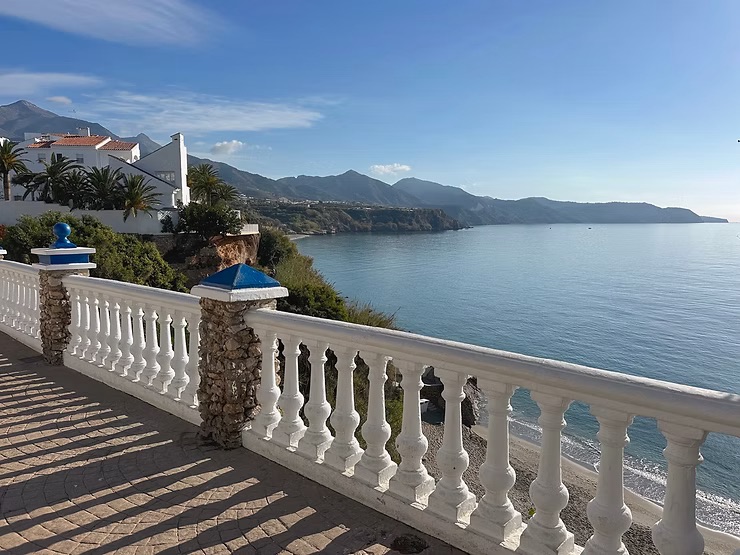
Nerja is almost a textbook example
Nerja is arguably an even stronger structural case than Spain generally.
Idealista's July data puts Nerja at a record €3,944/m², up 5.3% YoY, with Burriana around €5,000/m² and Capistrano around €4,273/m². The annual percentage has actually moderated from the double-digit increases seen earlier in the year, which is worth watching, although Idealista also introduced a methodology change in July.
More importantly, Málaga province's for-sale stock was still 6% lower YoY in Q2 2026, even while national inventory was down 7%. And Málaga has an unusually large international buyer base: recent Registradores-based figures put foreigners at roughly one-third of purchases in the province.
Nerja then compounds that with something extremely difficult to solve: you cannot manufacture much more Nerja. Geography, planning restrictions, established urban fabric, mountains, protected areas and limited developable coastal land make the supply elasticity fundamentally different from inland Spain.
So when somebody wants a two-bedroom apartment around Burriana, Parador, Carabeo, Capistrano, Torrecilla, etc., the solution isn't "developers will build another 15,000 apartments over the next three years." They can't.
That's incredibly important.
Fewer sales don't mean that the market is falling
BBVA's latest August analysis actually expects transactions to fall about 7.3% in 2026. But critically, they don't interpret that primarily as collapsing demand. They point to shrinking existing-home supply and insufficient construction as the main explanation, while forecasting roughly 220,000 new households this year.
That's an important market dynamic: fewer sales ≠ falling market.
You can have fewer transactions because owners aren't selling, buyers are struggling to find stock and prices have become expensive, while the desirable properties that actually reach the market continue appreciating.
So my view of the next few years
For Spain overall, I would not extrapolate 12–15% annual appreciation indefinitely. That's unsustainable relative to incomes. I would expect price growth to moderate, transaction volumes to become less spectacular and the market to become increasingly selective. CaixaBank's current outlook is essentially the same: continued price growth in 2026–27, but slower than 2025, with the most dynamic markets beginning to show some signs of exhaustion.
For places like Nerja, Marbella, prime Málaga, parts of Alicante/Balearics, etc., I would be considerably more bullish. There the supply problem is structural and international purchasing power means local Spanish salaries are not the sole determinant of what buyers can pay.
That's the fundamental difference I see:
2007: "Prices are going up, so let's build more houses and banks will finance everybody."
2026: "There aren't enough houses in the places where people actually want to live, and building enough of them is extraordinarily difficult."
Those two situations can produce superficially similar price charts while having completely different crash risks.
And in Nerja specifically, the scarcity of good second-hand stock is probably more important than the national percentage increase. If there are 10 serious buyers for a particular type of good property and only two owners willing to sell, the national Spanish housing index becomes almost irrelevant to the clearing price.
Teemu Ruuska, Co-Founder, Nerjawithsanna
Teemu is the General Partner of a Miami based (U.S.) early-stage sports tech fund. Teemu has founded several companies, exited two of them and has extensive experience in the Spanish Real Estate Market. An MBA in Sports Management from the University of Real Madrid, a Master's degree in International Business from EAE Business School, Madrid and an MBA from PowerMBA Business School tell their own story as well.